Here's a concept sketch of Disney Hong Kong, taken from a display at Disneyland Paris. I'm not sure how I feel about these very slanty eyes. I'm not all indignant, but I do wonder if a Chinese person actually drew this. Or someone who ever met a Chinese person.
Saturday, November 8, 2014
Monday, November 3, 2014
Disneyland Tokyo and the Single Rider Line
When Radiator Springs Racers opened at Disney’s California
Adventure it was a total boon for my niece and me. Rather than the rope drop
crowd of hundreds stampeding to Toy Story Mania with us, they were making a
beeline into Cars Land, leaving us to a relatively line-free first three trips
through the Toy Story midway. The line for Radiator Springs would suck people up all day,
keeping them in line and away from other rides.
| 180 minutes. A good day for Toy Story Mania. |
When lines get that long, park visitors often hop into the
single rider’s line. This line allows cast members loading the ride to make sure
every car goes out at full capacity. So Radiator Springs Racers with its 3-seat-per-row
configuration often accommodated a family of 4 (in 2 rows of 2) and 2 single riders, one per row. Awesome. If
you didn’t mind sitting with another group you could significantly cut your time in line, and plenty of people – particularly teenagers – did just that, hanging out
in the single rider line with their friends, riding with strangers, and
regrouping at the end of the ride to go their merry way.
![]() |
| 1/3 the wait. All of the fun. |
When I was at Disneyland Tokyo on Halloween this year they
sold out of tickets by noon. It was THAT crowded. I headed towards Splash
Mountain because it’s always a hoot to hear Zippity
Doo Dah in Japanese. The line was 150 minutes long. Fortunately, there
was a single rider line so I headed down.
Here is the single rider line at Splash Mountain, just
before boarding:
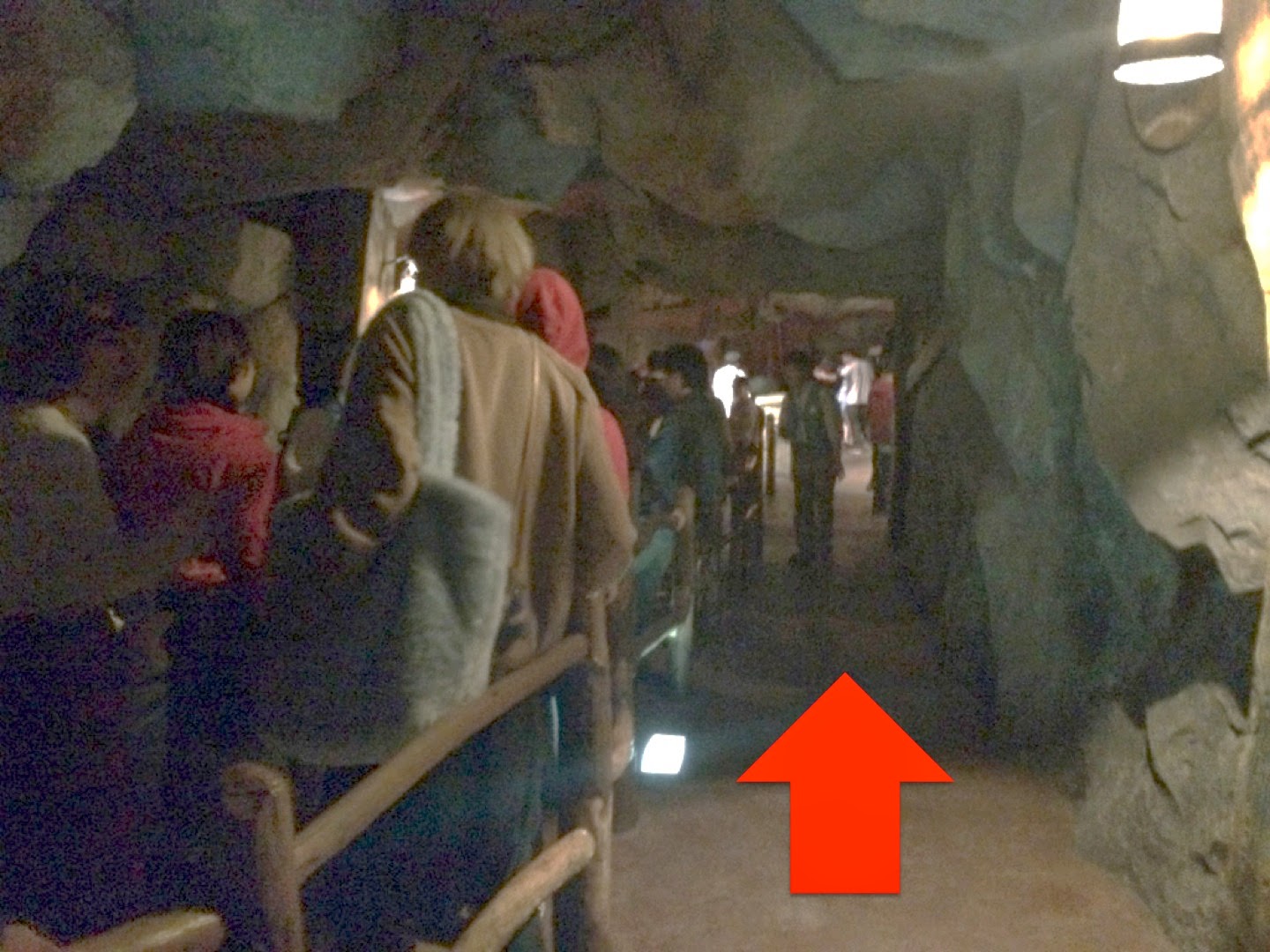
Don’t see it? Right. Too dark. Here it is lightened up, and I’ll point out the
line with an arrow.
Still don’t see it? Oh, right that’s because there ISN’T
anyone waiting. Not a SINGLE PERSON. That guy at the end, that's a cast member. With an over two-hour wait, no one wants to ride alone in
Japan, and no one wants to ride with strangers. You ride with the friends you
came with, or you don’t ride at all. It’s kind of a wonderful sentiment.
And if you look at the ride photos of everyone screaming on the Splash Mountain final drop, you’ll that almost every single car has at least one empty seat.
To be fair to Tokyo Disneyland, I think they realize this,
because Splash Mountain has the only single rider line in the entire park, and I wouldn’t be
surprised if they stopped using it entirely. No one wants to be a single rider
in Japan.
I’ve spent the last two and a half years working here to try
to bridge Western and Japanese efforts towards sustainable seafood, and one of
the things I’ve repeatedly stressed to the Westerners I work with is the need to belong to your group. Breaking from the pack and doing something different or doing something alone is a pretty big
deal, and asking for it to happen a pretty big non-starter. So for now there's a lot of conversation about the topic, and not much doing of anything. To my thinking this is okay. Because at some point if you can get the group to agree, when
they do something, they do it together and they do it en masse. This gives me a tremendous amount of hope for
Japan, and when I see that completely empty single riders line it does feel like Disneyland Tokyo is the happiest
place on earth.
Sunday, June 8, 2014
Red Hot Frozen
Every once in a while an unexplained cultural phenomenon hits us. In my childhood it was Cabbage Patch Kids: ugly, expensive, wearing impossibly unfashionable clothes. In the 90's there was Tickle Me Elmo, with its creepy unending giggles that made you think you may wake up one night to see it holding a knife.
By now it's no news that Disney's Frozen is the unprecedented phenomenon of the decade. Even without any kids in the house, I'm aware of this, from the Facebook posts to the Disney blogs to the sudden appearance of Frozen Sing-Along movies at my local theater.
Going to Walt Disney World is like heading to Frozen central. It's completely CRAZED. Disney does a good job in keeping the chaos contained. The Princess Fairy Tale Hall is indoors, so I didn't see how many thousands of people are packed inside, but families can wait FIVE HOURS to meet Anna and Elsa.
While the Bippity Boppoty Boutique is churning out hundreds of little princesses a day, there's not a single Elsa coming out of the Disney boutiques because they simply can't keep the costumes in store. A few times I did catch glimpses of an Elsa skipping through the park - those lucky kids had parents who thought ahead to hunt down the costumes on eBay prior to visiting the park.
By now it's no news that Disney's Frozen is the unprecedented phenomenon of the decade. Even without any kids in the house, I'm aware of this, from the Facebook posts to the Disney blogs to the sudden appearance of Frozen Sing-Along movies at my local theater.
Going to Walt Disney World is like heading to Frozen central. It's completely CRAZED. Disney does a good job in keeping the chaos contained. The Princess Fairy Tale Hall is indoors, so I didn't see how many thousands of people are packed inside, but families can wait FIVE HOURS to meet Anna and Elsa.
| Why yes, I will wait 300 minutes to meet some college girls wearing princess dresses. |
While the Bippity Boppoty Boutique is churning out hundreds of little princesses a day, there's not a single Elsa coming out of the Disney boutiques because they simply can't keep the costumes in store. A few times I did catch glimpses of an Elsa skipping through the park - those lucky kids had parents who thought ahead to hunt down the costumes on eBay prior to visiting the park.
| She doesn't know how lucky she is. |
| Nope, Frozen isn't just for little girls either. |
The whole franchise is so popular now that in all the Disney shops there are Frozen sections with tags telling potential customers that they are limited to five items per person unless otherwise specified. Of course, with the feeding frenzy from other Frozen fans it's likely that your five items will be Frozen frosted cookies and Olaf t-shirts, rather than Elsa costumes or dolls.
Last week, I ducked into every princess store I passed without seeing Elsa dolls or costumes. On the last day, bingo! An entire wall of Elsa dolls, recently arrived that morning. The cast member estimated they got a thousand dolls, and would be sold out by early afternoon. Customers who were interested in buying it but wanted to come back later in the afternoon so they didn't have to carry it all day were advised to buy it now and put it in a locker.
| Don't let her Snow White dress fool you: she really wants to be Elsa too. |
I'm now hunting down references to just what Frozen has accomplished in real terms. So far, I've discovered that Elsa is the most profitable princess. Tourism in Norway is up: 152% more searches for flights to Norway, triple the normal visits to the Norwegian tourism web site. And more "Let It Go" covers than you can shake a stick at.
I can't for the life of me figure out why it's all so popular. If you have any ideas, let me know. Or maybe I should just let it go too.
Sunday, June 1, 2014
Welcome Home
When I spent three weeks in Tokyo on my own last year I got pretty lonely. Not only was I away from all of my friends and family, but being in a completely different environment where I couldn't even say "good morning" to the Seven-11 clerk became thoroughly depressing. So I went to Tokyo Disneyland, looking for familiarity, for a little bit of America in the middle of Japan. It was as close to home as I was going to feel until I managed to land back in San Francisco. Somehow, even though the Country Bears sang "On the Road Again" in Japanese, it made me feel like I was home.
Lately I've started talking to people about their connection to Disney, and have been surprised how often this word "home" is used. They don't even need to go on rides, or meet familiar characters. Sitting on a bench on Main Street, watching the crowds go by, is all the experience they need to feel like they are home again.
For some people, particularly in southern California where it all originated, it's not just their home but a familial home, kind of like Windsor Castle for the British royals. (And like Windsor Castle, tourists visit your home all the time, but it's still your home.) I've spoken with people who are now into building fourth-generation memories in the Disney Park home. Their parents were at Disney when it opened. They visited with their parents as kids, and when they had their own kids, brought them to the parks to share their own special memories and build new ones. And now their grandkids are layering on that emotional attachment to the family home.
And this is where the Disney understanding of its brand power comes in for the kill. With products like Disney Vacation Club and the Disneyland annual passport (as well as the Premier Passport for both Parks), the Disney Company invites people to come back to Disney parks again and again, every year, for the $98/day park tickets and $4 bottles of water that keep the shareholders happy. And with every trip and with every new generation, the parks become more of home, the attachment stronger.
When Disney created the park he was inspired by his weekly visits with his daughter to the local park. He wanted something bigger, that the whole family could enjoy together. I wonder if he could see into the future at the parks that have grown out of his dream, what he would have thought.
Lately I've started talking to people about their connection to Disney, and have been surprised how often this word "home" is used. They don't even need to go on rides, or meet familiar characters. Sitting on a bench on Main Street, watching the crowds go by, is all the experience they need to feel like they are home again.
For some people, particularly in southern California where it all originated, it's not just their home but a familial home, kind of like Windsor Castle for the British royals. (And like Windsor Castle, tourists visit your home all the time, but it's still your home.) I've spoken with people who are now into building fourth-generation memories in the Disney Park home. Their parents were at Disney when it opened. They visited with their parents as kids, and when they had their own kids, brought them to the parks to share their own special memories and build new ones. And now their grandkids are layering on that emotional attachment to the family home.
And this is where the Disney understanding of its brand power comes in for the kill. With products like Disney Vacation Club and the Disneyland annual passport (as well as the Premier Passport for both Parks), the Disney Company invites people to come back to Disney parks again and again, every year, for the $98/day park tickets and $4 bottles of water that keep the shareholders happy. And with every trip and with every new generation, the parks become more of home, the attachment stronger.
I know there are other places people think of as "home." It's usually somewhere familiar, where they've spent happy times over repeated visits. For me it's also Las Vegas (particularly Circus Circus) and Hawaii and the Dish hike in the Stanford foothills. It's even something more intangible like Star Trek and the smell of dried California chaparral. But I've yet to find a place that so systematically builds on this product of home.
| At the entryway of Animal Kingdom Lodge. |
When Disney created the park he was inspired by his weekly visits with his daughter to the local park. He wanted something bigger, that the whole family could enjoy together. I wonder if he could see into the future at the parks that have grown out of his dream, what he would have thought.
Saturday, May 10, 2014
"How tall IS he, anyway?"
Just a short and quick observation. When you're at any of the Disney parks, there are handy boards around that tell you how long the wait time is for each ride. This saves you from trekking across the length of the park only to find that the wait for Space Mountain is 2 hours.
If you hang around these boards you can hear how people plan and negotiate with each other. Which I was doing in Anaheim, when a family came by with their son. "Oooo, Splash Mountain is 55 minutes! David would like that." David, maybe 4 or 5 years old, nods vigorously. Then "Minimum 40 inches. Is he 40 inches? How tall IS he, anyway?" Parents look at each other blankly.
Because, of course, neither parent decisively knew. Kids that age sprout like bean stalks, and the last time you measured could have been 2 inches ago?
Once you get to the ride, the cast members have sticks to measure your kid. But if you're doing your planning at the board, it's a lot harder. It's actually impossible, because you can't measure at the board.
Easy experience design upgrade: measuring post located at all attraction boards, and everywhere else where people commonly stop to figure out their next ride.
If you hang around these boards you can hear how people plan and negotiate with each other. Which I was doing in Anaheim, when a family came by with their son. "Oooo, Splash Mountain is 55 minutes! David would like that." David, maybe 4 or 5 years old, nods vigorously. Then "Minimum 40 inches. Is he 40 inches? How tall IS he, anyway?" Parents look at each other blankly.
| 40" - 46" - 54" - who really knows how tall their kid is? |
Because, of course, neither parent decisively knew. Kids that age sprout like bean stalks, and the last time you measured could have been 2 inches ago?
Once you get to the ride, the cast members have sticks to measure your kid. But if you're doing your planning at the board, it's a lot harder. It's actually impossible, because you can't measure at the board.
Easy experience design upgrade: measuring post located at all attraction boards, and everywhere else where people commonly stop to figure out their next ride.
Liberté, Egalité, Fraternité, and Pin Trading
The national motto of France is Liberté, Egalité, Fraternité, and it's also quite possibly the motto of everyone in the service industry in Paris. If you've ever been to a restaurant or cafe in Paris, you'll know what I'm talking about. I think it's the "egalité" part - equality - that trips up the service industry. Americans in Paris blog about this, the "I'm not your slave" attitude where people in the service industry try to prove you're not better than they are by not bringing you anything until they're good and ready, and smoking cigarettes while standing next to your table. .
I was interested in service at DLP because the service culture is so very different. US Disneys have incredible service. The cast members are cheerful, engaging, smiling, and helpful. The Japanese, a service-driven culture, excels at it even more than the US. At Disneyland Paris, the American training in service has clearly not quite caught up with the cast members. Rob was unable to get change from a few cast members who were standing in front of a pile of change. "It's not possible," they insisted, deadpan. All THREE of the cast members, while standing in front of about 30 Euros in change.
I had even more fun with this when trying to trade pins. Pin trading is a very prescribed interaction.
"May I see your pins," I ask the cast member.
"Of course," they smile, and hold out their lanyards for examination.
At this point you may trade any two of your pins for any two of their pins. Disney produces thousands of different types of pins, some unique to the park, some only available through trading. People are really into this. Fully grown adults, with children, will walk around the park with three pounds of pins around their necks. There are pin-only web sites for discussion and learning, pin trading stations in the park, even pin trading conventions. At Disney Tokyo, pin trading was so remarkably successful that they had to shut it down, because it changed the entire experience of the park. Now you can only buy pins there. Next time you're at a park, pay attention to people with pins. It's a not-so-secret club, a different layer to the Disney experience.
At about $7 per pin, this is also quite a lot of money in Disney's pocket. And this is where Disneyland Paris is different from the US. Disneyland Paris has struggled because of the lower per-guest expenditure compared to US parks. Getting a guest to shell out even more money is just not happening. It's clear that DLP is trying to encourage pin trading, by having more cast members wear lanyards.
The cast members, however, are French. Not only do they not understand pin trading, they don't like being "summoned" to show their pins. And when they do, it wasn't unusual for me to be faced with some kind of egalité-demanding action on their part.
"I want that pin," one cast member said, pointing to my treasured Cheshire Cat.
"I like that one," I said. "I want to give you this one."
"I can choose," she insisted. "That's the way it works. You choose mine, I choose yours. It's fair that way."
"That's not how it works," I protested.
"Yes it is," she says. And then she pulls her co-worker over. "She chooses and I choose, right?" Two against one. I lose.
In the end she got my Cheshire Cat, because I was just so bemused and shocked at this kind of assertiveness. I got the distinct impression that she knew exactly what the rules were. She just didn't want to live by them.
This wasn't the only time I had pin trading turned on its head in Paris either. The French are not okay with being in different positions of power. Certainly there were many cast members who understood the rules, even if they couldn't figure out how to display a lanyard correctly. But the attitude is just different. It was clear that they were not out to make a magical day for me. They had a job to do - making cotton candy, ringing up purchases at a register - and it did not involve some American coming and choosing pins from their collection while they had no say at all in the interaction.
Liberté, Egalité, Fraternité
I was interested in service at DLP because the service culture is so very different. US Disneys have incredible service. The cast members are cheerful, engaging, smiling, and helpful. The Japanese, a service-driven culture, excels at it even more than the US. At Disneyland Paris, the American training in service has clearly not quite caught up with the cast members. Rob was unable to get change from a few cast members who were standing in front of a pile of change. "It's not possible," they insisted, deadpan. All THREE of the cast members, while standing in front of about 30 Euros in change.
I had even more fun with this when trying to trade pins. Pin trading is a very prescribed interaction.
"May I see your pins," I ask the cast member.
"Of course," they smile, and hold out their lanyards for examination.
| Anaheim cast member displaying pins in perfect form. Note the smile. |
At this point you may trade any two of your pins for any two of their pins. Disney produces thousands of different types of pins, some unique to the park, some only available through trading. People are really into this. Fully grown adults, with children, will walk around the park with three pounds of pins around their necks. There are pin-only web sites for discussion and learning, pin trading stations in the park, even pin trading conventions. At Disney Tokyo, pin trading was so remarkably successful that they had to shut it down, because it changed the entire experience of the park. Now you can only buy pins there. Next time you're at a park, pay attention to people with pins. It's a not-so-secret club, a different layer to the Disney experience.
| These people are wearing at least $150 in pins on their chests. |
| My collection. Sometimes it makes me happy just take them out and look at them at home. |
At about $7 per pin, this is also quite a lot of money in Disney's pocket. And this is where Disneyland Paris is different from the US. Disneyland Paris has struggled because of the lower per-guest expenditure compared to US parks. Getting a guest to shell out even more money is just not happening. It's clear that DLP is trying to encourage pin trading, by having more cast members wear lanyards.
The cast members, however, are French. Not only do they not understand pin trading, they don't like being "summoned" to show their pins. And when they do, it wasn't unusual for me to be faced with some kind of egalité-demanding action on their part.
"I want that pin," one cast member said, pointing to my treasured Cheshire Cat.
"I like that one," I said. "I want to give you this one."
"I can choose," she insisted. "That's the way it works. You choose mine, I choose yours. It's fair that way."
"That's not how it works," I protested.
"Yes it is," she says. And then she pulls her co-worker over. "She chooses and I choose, right?" Two against one. I lose.
In the end she got my Cheshire Cat, because I was just so bemused and shocked at this kind of assertiveness. I got the distinct impression that she knew exactly what the rules were. She just didn't want to live by them.
This wasn't the only time I had pin trading turned on its head in Paris either. The French are not okay with being in different positions of power. Certainly there were many cast members who understood the rules, even if they couldn't figure out how to display a lanyard correctly. But the attitude is just different. It was clear that they were not out to make a magical day for me. They had a job to do - making cotton candy, ringing up purchases at a register - and it did not involve some American coming and choosing pins from their collection while they had no say at all in the interaction.
Liberté, Egalité, Fraternité
Saturday, May 3, 2014
When Good Designs Go Bad
The person who designed FastPass should win an award. I'd like to see a statue of him next to Mickey Mouse in front of the castle. He was an experience design genius.
If you're not familiar with it already, this is the system that lets you survive those "Crowd Level: 10" days. You stick your park ticket in a machine, it spits out another ticket with a time window that allows you to the front of the line. You then waltz off to find your smoked turkey leg or to trade pins or to ride something with a shorter line, returning later to smirk at schmucks in line while you cruise past them with your FastPass.
I wonder if Disney has ever tracked the amount of money that FastPass has made them. People standing in line spend zero money. People strolling through the park do - a T-shirt here, a Mickey-Mouse-shaped popsicle there - it must add up. The guests love it too. No one wants to stand in line. One of the most common complaints on Tripadvisor about Disney is how much standing in line your near-$100 ticket just bought you.
FastPass is a win-win system. Disney wins, guests win.
In Disneyland Paris, FastPass only kinda sorta worked. Return windows were shorter (15 minutes instead of 30 or 60). Rides broke down right when your return window opened, meaning you just wasted your precious FastPass on NOTHING.
Worst of all, the lines for FastPass were ridiculous. It was possible to stand in a 15-minute line to get a FastPass, so that you could later criss-cross the park to stand in line for another 30 minutes to get on a ride.
Once you got through the line to a machine, even getting a FastPass presents problems. In the US Disney Parks, you put your ticket in, you get a ticket out. Simple self-service.
In Paris, getting a FastPass out of a machine was like getting a smile out of a Parisian waiter. Good luck with that, sucker! At each FastPass station, harried employees scuttled between machines, helping guests wrangle the machines into submission. I counted 2 employees for every four-machine station. Every once in a while, even the employees gave up with the tickets, and just opened the machine to manually force a FastPass to be printed.
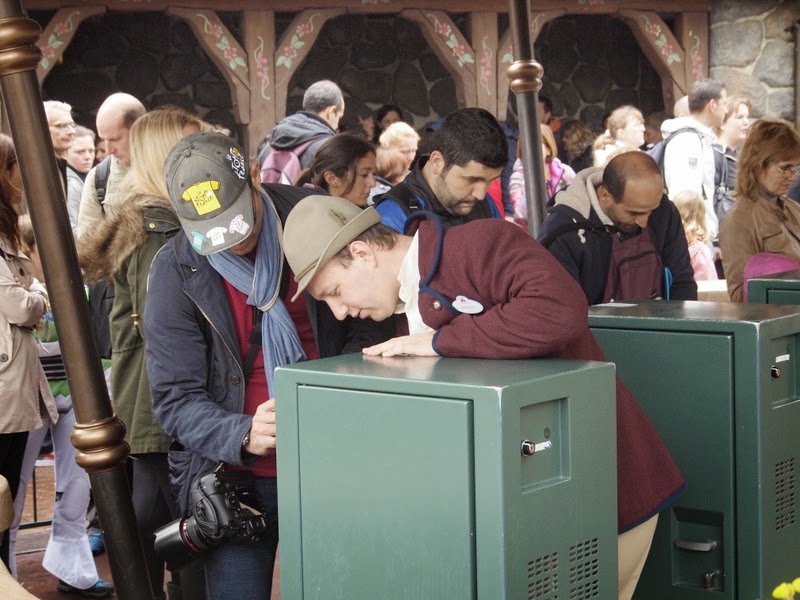
One of the major problems in Paris is that there are at least THREE kinds of tickets being scanned by machines. Magnetic stripe tickets, bar code tickets, full A4 size printed-at-home tickets. Why DLP allows this I have no idea. But there were two kinds of scanner in each machine, and people couldn't figure out where their ticket should go.
According to another blog this two-reader system was supposed to be an improvement. But people ran the magnetic stripe backwards, stuck their bar code ticket IN to the machine (kinda like the drawing suggests) rather than putting it parallel to the surface, didn't know what to do with their printed-from-home tickets. The instructions were non-existent or confusing. The printers were slow. Rather than taking a few seconds a ticket, it was taking 15 or 45 seconds a ticket. And with guests like the lady in front of me running 16 tickets at a time for her group, we were all in for a long wait.
Why Disney doesn't just issue one type of ticket is beyond me. Print-at-home tickets also exist here in the US, but are traded in for standardized tickets in Anaheim at the gate.
With design the devil's in the details - always. There's no reason FastPass can't work more smoothly, even with three kinds of tickets. Even creating a better graphic instruction and slapping on a sticker would help here.
If Disney does track how much money is spent when people have FastPasses, this would be an interesting question. How much money is not being spent at Disney when people are standing in FastPass lines?
If you're not familiar with it already, this is the system that lets you survive those "Crowd Level: 10" days. You stick your park ticket in a machine, it spits out another ticket with a time window that allows you to the front of the line. You then waltz off to find your smoked turkey leg or to trade pins or to ride something with a shorter line, returning later to smirk at schmucks in line while you cruise past them with your FastPass.
I wonder if Disney has ever tracked the amount of money that FastPass has made them. People standing in line spend zero money. People strolling through the park do - a T-shirt here, a Mickey-Mouse-shaped popsicle there - it must add up. The guests love it too. No one wants to stand in line. One of the most common complaints on Tripadvisor about Disney is how much standing in line your near-$100 ticket just bought you.
FastPass is a win-win system. Disney wins, guests win.
In Disneyland Paris, FastPass only kinda sorta worked. Return windows were shorter (15 minutes instead of 30 or 60). Rides broke down right when your return window opened, meaning you just wasted your precious FastPass on NOTHING.
Worst of all, the lines for FastPass were ridiculous. It was possible to stand in a 15-minute line to get a FastPass, so that you could later criss-cross the park to stand in line for another 30 minutes to get on a ride.
Once you got through the line to a machine, even getting a FastPass presents problems. In the US Disney Parks, you put your ticket in, you get a ticket out. Simple self-service.
| Simple interface at a US FastPass kiosk |
| Cast member helping a guest figure out how to scan his bar code. |
One of the major problems in Paris is that there are at least THREE kinds of tickets being scanned by machines. Magnetic stripe tickets, bar code tickets, full A4 size printed-at-home tickets. Why DLP allows this I have no idea. But there were two kinds of scanner in each machine, and people couldn't figure out where their ticket should go.
According to another blog this two-reader system was supposed to be an improvement. But people ran the magnetic stripe backwards, stuck their bar code ticket IN to the machine (kinda like the drawing suggests) rather than putting it parallel to the surface, didn't know what to do with their printed-from-home tickets. The instructions were non-existent or confusing. The printers were slow. Rather than taking a few seconds a ticket, it was taking 15 or 45 seconds a ticket. And with guests like the lady in front of me running 16 tickets at a time for her group, we were all in for a long wait.
Why Disney doesn't just issue one type of ticket is beyond me. Print-at-home tickets also exist here in the US, but are traded in for standardized tickets in Anaheim at the gate.
With design the devil's in the details - always. There's no reason FastPass can't work more smoothly, even with three kinds of tickets. Even creating a better graphic instruction and slapping on a sticker would help here.
If Disney does track how much money is spent when people have FastPasses, this would be an interesting question. How much money is not being spent at Disney when people are standing in FastPass lines?
Subscribe to:
Posts (Atom)