Sunday, March 30, 2014

What's Experience Design?

I went down to LA last week. It was kind of a tour of all my old haunts growing up in Los Angeles. We stopped for a few days in Ojai where had I attended astronomy camp when I was 16. I introduced Rob to the La Brea Tar Pits (literally "The The Tar Tar Pits," our tour guide translated for us) where mammoth bones were till being dug up under the busy streets of Los Angeles. And we made a stop at Universal Studios as well as my favorite past and present haunt, Disneyland.

I haven't been to Universal Studios Hollywood since I was a kid, and they've really expanded and spiffed up the place. They've got some of the most state-of-the-art motion simulator rides anywhere, including one where you enter Springfield with the Simpsons for a wild ride through Krustyland, and another where King Kong and dinosaurs attack your backlot studios tour tram. The rides are all beautifully done.


The Despicable Me Minion Mayhem ride doesn't open until later this year, so I paid $84 for my Universal Studios annual pass optimistically hoping that I can return later when the Minions arrive. It seemed like a total bargain. The Disneyland annual pass I bought last August - the price for that was $669. Yep, you got that right. $669. Almost eight times more than what I paid for an equal number of days at Universal studios.

What in the world is Disney doing that Universal is not to warrant such blind fork-over-my-money loyalty?

Janitor cart at Disney.
Disney is one of those very rare companies in the world that understand they are creating an experience rather than a product or a series of products. To execute Walt's vision of creating the "Happiest Place on Earth," the Disney company treats a visit to the park as a single cohesive magical experience rather than a piecemeal trip to rides and attractions. That means all the details, from the cast member costumes to the choice of bathroom tiles, every touch point the guest sees has been thoughtfully designed to create the sense that you have left your everyday world and gone to a place where everything is different, beautiful, magical.

So on California Screamin', a roller coaster in the nostalgically-themed Paradise Pier section of California Adventure, the ground underneath the roller coaster isn't asphalt, it's beach sand and reeds because Paradise Pier is the re-creation of an early American boardwalk, the kind commonly found in turn-of-the-century California beaches. They carry this theme through the landscaping, the buildings, the lettering advertising Disney's obiquitous (and mysteriously large) turkey legs. Even the janitor pushcart is themed. The long lines for Toy Story Mania are cooled by lazily rotating wooden ceiling fans.

They didn't build the coaster on sand, but it sure looks like they did.

Meanwhile, over at Universal Studios, guests who were hot waiting in line outside of Shrek's castle were treated to an industrial fan plunked on the concrete path to cool them down. And once they got inside Shrek's castle, they walked through passages which looked remarkably like a DMV corridor before they got into the themed ride.

Just what I think the inside of Shrek's castle looks like.
Disney is so thorough in thinking through each step of the experience that even their emergency protocols take the guest experience into account. Emergencies like fires. While I was at Walt Disney World a few years back, a fire broke out at the Bibbidi Bobbidi Boutique in Orlando. This was a place where little girls were transformed every day into princesses by a legion of ladies-in-waiting who help them with dresses, hair, make-up, shoes, and most importantly, the attention and royal treatment that every princess needs. As I was talking to a mom waiting for her daughter to come back out, we noticed a subtle but sudden change of pace as the ladies in waiting quickly and efficiently gathered up their young charges and took them outside. The adults waiting in the store were evacuated by the staff.

What was magical about watching this is that the little girls hardly noticed. Their ladies-in-waiting stayed in character, keeping their voices gentle and even, bringing out magic wands and picture books, sitting under trees with the children, and reading to them while the fire department showed up and put out the electrical fire. With sirens completely off.

This type of coordination doesn't happen by accident. It happens because Disney had hired someone (probably a team of someones) to think very long and hard about the experience those little girls parents wanted for their princesses, and then made sure there were plans in place to preserve that experience from beginning to end.

"Design" is one of those newfangled terms people often don't agree on. Some people think it's about nice elegant curves, or extra functions that didn't exist before, or the right color on a phone. I think it's all of that but more than that. "Design" is taking that extra step in thinking about what it is you're doing - really taking the time to figure out what the vision is and how it fits into the world people want to have.

In the end, Disney's rides aren't eight times better than Universal Studio's. There aren't eight times more of them. But as a guest, the eight times more that I pay for my annual pass goes towards a kind of guarantee that I am buying a different kind of experience - the kind experience that requires planning what the bottom of a roller coaster looks like, and what happens if a blow dryer catches fire on my little girl's special day. That's worth $669 a year.


Sunday, March 23, 2014

Prejudice

A Disney trip is not for the weak. In the section titled "The Vacation that Fights Back," the Unofficial Guide to Walt Disney World writes "Visiting Disney World requires levels of industry and stamina more often associated with running marathons." Pedometers regularly rack up over 10 miles of walking every day at Disneyland. And since I (like many others) do the doubling-back-repeatedly strategy to avoid long lines, every full day I've spent in the Disney parks has been marked by 11 to 15 miles of walking. The Unofficial Guide also recommends that families train for this by going for longer and longer walks prior to their arrival at the parks, just so they can have the stamina to see what they want to see.

But the tourists are fighting back against this vacation.

I just returned from Disneyland Anaheim and was struck by the number of people I saw in scooters. A family of four adults and a child zoomed by me, nearly knocking me down on the sidewalk as they sped towards their restaurant. All four adults were rotund, with no noticeable necks and legs that came to small, clearly under-used feet. One scooter had a very large round child on a lap, clearly learning the ways of a life of not walking. Inside the park, scooters sometimes seemed so prevalent that it felt like a scene out of Wall-E.


It's hard not to feel a little prejudiced. Just walk a few blocks, I would think resentfully. It's not like you can't use some exercise. After two days and 24 miles of Disney, my feet and legs ached and it felt like I was paying a price that these scooter people somehow were exempt from. They went everywhere I went - in stores, in restaurants, on rides. To deepen the wound, they didn't even have to stand in line at Disneyland, which was built before the Americans with Disabilities Act was instated in 1990 and had narrow lines that didn't accommodate wheelchairs and electric vehicles. They just scooted up to the ride and got a hand-written pass that told them when to return. Then they zoomed off to shop or eat or just sit in the shade until their return window came up. Meanwhile, I had to stand in line, being told by friendly yet firm cast members to get off from sitting on the railing to rest my feet.

A family gets their special-access pass from a Cast Member.
I felt resentment - oh yes. And laid on the judgement heavily, at least in my own head. These lazy people should just get off their fat bums and suck it up like the rest of us. Sore feet is part of the experience, and if they're too lazy to walk it maybe they shouldn't be here.

But then I started talking to them, and immediately and with much shame I realized how incredibly prejudiced I had been.

People are on scooters because it makes it possible for them to be in the park with their family. Weight doesn't just make walking more work, but often exacerbates existing conditions and comes with its own host of other physical ailments that make even a mellow 5-mile walking day something of an impossibility. It's not even all about weight. Arthritis, back problems, even something as simple as chafing will keep you from keeping up with your teenagers. One woman in her 60's lamented to me that she can't sit or stand for any length of time because of her back. So she drives the scooter, and then sometimes switches out and lets one of her grandkids drive it while she walks.

And once I started talking to people, I started to see them. Actually see them, not just with my prejudices. Young and old, overweight and thin, in groups of friends or families or even on their own. Enjoying the park, just as I was, finding ways around their limitations. Limitations I was lucky enough to not understand. I wondered what limitations put them in scooters, and then reminded myself that it didn't matter.

I left this trip with a sense of humility and awe at what we've managed to achieve as a society. Certainly America has issues with its weight, and this is something we'll need to figure out before we can get our health care costs under control. But we have also managed to pass laws and build systems that allow people to stay together and experience a physically demanding park despite their own disabilities. I'm awed by the silver-haired grandmother keeping up all day with her grandkids, by the ride designers who have made it possible for a paraplegic to hang-glide on Soarin', by the cast members of Aladdin who thought it was a good idea to have a woman in a wheelchair dancing along with everyone else on stage a la Glee. I'm awed by the spirit and cohesiveness of families that figure out how to stay together on a 10-mile park day despite crippling arthritis.

I hope the humility is something I remember next time my "J" side kicks in with a rude prejudice. It's so easy to just assume and blame when that healthy-looking young man takes the handicap parking space at the gym. But it might just be time for me to get off my lazy ass.


Sunday, March 9, 2014

A Whole New World

So this morning my house was filled with the unhappy crescendo of "No!!! NOOOOOO!!!!" NOOOOOO!!!" Followed by much swearing and other things that shouldn't be repeated. What was the cause of this crisis? I had received my "Introducing MyMagic+" pamphlet from Walt Disney World, and was being shoved into A Whole New World, like an unwillingly genie into a new yucky bottle.

The arrival of this pamphlet caused much discontent.

For those of you who aren't up on Disney news, MyMagic+ is the new streamlined ticket/payment/FastPass system that uses RFID wristbands to govern your park experience. It allows Disney to track traffic patterns, adjust their staffing to accommodate the load, and generally create a more seamless experience.

Except.

Mental NOOOOOOOOOO!!!! echoing in my head...

This is my new planning nightmare because of the FastPass+ system. Instead of going into a park on the day of and collecting tickets that take you to the front of the line, you now get to book them 60 days in advance. Now, it's I'm a self-confessed OCD planner. Ninety percent of the arguments in my house happen because I think January is a perfectly reasonable time to book hotels and buy flights for Christmas because that's when you have the most options. Get a jump on the crowds. Grab those tickets before they're gone. The reservation system is open, and people like me get the most out of it while the slackers lose out. SUCKERS!!! Countries have been invaded with less planning than I put into my trips. I am a Planner. 

It seems like I should love that FastPass+ will let me grab FASTPASSes a whole two months ahead. So what's missing here?

Planners (at least, planners like me) don't plan because we want to. We plan because we feel like we have to. Not planning will put you behind all the other people who got their act together early, sat down, and figured out what they wanted. The fact that FASTPASS planning wasn't possible until the day of the park relieved me of one of the burdens of planning. OCD planners like me get to enjoy very little spontaneity, and the Disney vacation was one of them. Now they are taking it away, and I am very, very sad.

There's also a certain joy in the anticipation that builds the morning before a day at the park. You sit at breakfast with your family talking about the rides you want to do that day. You stand at rope drop making plans - "I'll run for the California Screamin' rope drop while you make a beeline for Toy Story Mania." All of this builds a sense of excitement for the day, and is part of the park experience. 

I have a hard time imagining getting that excited sitting down with my family 60 days before our visit planning what we're going to do. I have a hard time imagining that I can get my family to even participate in this conversation. Two whole months before the visit is not when anyone knows what time they want to ride Space Mountain. 

SO. Here we are now in this Whole New World. I'm not closed to the possibility that it will be wonderful. Some people online say that they love sleeping in knowing that they can still get on rides because they don't have to get their FASTPASS before it's gone. I'm sure my husband will love that. (The sleeping in, not the planning 60 days early.) But it is a game changer with some pros and what I think are many cons. There are a ton of bugs to be worked out.

Of course, this means that it's a whole new research project for me. New technology challenges, new behaviors, new systems of crazy-fan behavior, different constituencies all trying to grapple with this behemoth of a system to figure out how to make it work for them. Time for me to plan my Disney World research run.


Friday, January 3, 2014

Lingerie fun

I've been a little Japan-focused, I know. You play with the cards you're dealt, and last year I was dealt a whole lot of Tokyo. It's now 2014, and I'm looking forward to trips to Disneyland Paris and Disney Hong Kong. I'm inexplicably excited about Hong Kong, even though the fan buzz says it's the least exciting one. But they serve tea in the English tradition, which seems a great idea in a place where you may be very tired, and I do wonder how they deal with the Chinese element. Perhaps over Chinese New Year it'll be fun to go.

Before I get into that though, I just need to share one more Japanese Disney item. This one came to me via my fellow humanity-watcher Annie, to whom I'm very grateful for unearthing such a gem. I don't know what to make of it, but I thought I'd share and see what you think:


Weird, right? Or more accurate, my original thought was ohmygodwhatthehell?!??

But then I stopped and really thought about it, and I can't decide if it's actually a bad thing. I mean, presumably these sexy little lingerie items (or, as a British friend once called underwear - "smalls") are meant for adults. And sexy stuff for adults should be perfectly fine.

Princesses are sexualized everywhere else as well, but for kids it's a different issue. Shouldn't that disturb us more? It's not even a thing of the past. The controversial transformation of Merida into babelicious-Merrrida in the most recent Disney princess movie was just yet another example in a long line of sexualized princesses sold to little girls. 


The Bibbidi Bobbidi Boutique in Orlando does a brisk business putting make-up, nail polish, and high heels on little girls as young as 3. Fan sites tell parents to book as far as 180 days in advance to make sure they can have the magical transformation of their daughters. 


In Japan the princesses I've seen have tended to be young women. Sexy, yes, but women

And the little girls - well, they seem more like little girls. In Alice outfits made of breathable cotton. And sneakers.


It makes me wonder whether the princess lingerie is disturbing only to us because our little girls love princesses and ewwwwww little girls in princess lingerie. But that's our issue and not the Japanese. Meanwhile we're putting nail polish and make-up on 3 year olds ewwwwwwww!  So here's the conundrum: what's actually more disturbing?

By the way - for my European friends with children - we're planning a trip to Disneyland Paris to check out how the Europeans do Disney. Wait - what am I thinking - you don't need children to have fun at DLP. Anyone at all - either first or third week of April. Interested in joining?

Wednesday, November 13, 2013

Lines, lines, lines

Apparently there's a Disney Shanghai in the works, to be opened in 2015. I had toyed with the idea of holding off on my "year of Disney" so that Disney Shanghai's opening can be my last Disney park, but one thing stopped me. Lines. 

I don't have a particular aversion to lines. When I go with Heather we have a 20-minute limit our lines, guided by a variety of phone apps (which usually don't entirely agree with each other). We've got our strategy down to a science: rope drop, Fastpasses, pin trading during the busy hours. Lots and lots of walking. Last summer when we were there we averaged 12 miles a day. When I'm on my own or with friends I don't mind lines up to an hour, especially since the waiting areas are so well themed and so interesting to look at.

What shocked me was that in Japan, people were willing to wait for six hours in line for a single ride. Yep, you read that right. Six hours. 2012, opening of Toy Story Mania in Tokyo. Oh. My. God. 
Seriously - check out that standby time.

Now, if you've not been on it, Toy Story Mania is an amazing ride. You sit in little carts and snake through a 3-D midway of carnival games with your shooter that throws out rings, paint balls, darts, and everything else. There are Easter eggs in the ride for guests in the know, where you can wrack up record-breaking points if you know exactly what to shoot at, and when.

It's awesome. It's always the first ride we run to after rope drop, and the last ride we go on before heading home.

Is it 6 hours waiting worth of awesome? I'm not sure. But I sure as heck wasn't braving these crowds in Tokyo to check out the Japanese version of the ride.

Only three hours from this point!

The Japanese are great with lines and with crowds. They don't seem to mind it the way we do. Kids entertain themselves, people chat with each other. It's genteel. It's orderly. There's a slight buzz in the air. The point is to see it when everyone else sees it. Or, preferably, before everyone else sees it.

Apparently this massive crowd gathering happened when Tokyo Sky Tree, the tallest structure in Japan, opened. The entire population of Tokyo tried to get to it when it opened, leading to three-month wait times just to get in the tower. A friend of mine visiting relatives in Tokyo was put on a bus, driven around the Sky Tree (but not allowed in) and then driven to the Tokyo Tower consolation prize, where he could go up and look at the Sky Tree from the previous highest point in Tokyo.

Yep, Japanese people are tolerant of lines, and tolerant of crowds.

So how does this get back to Shanghai? Well, I'm Chinese, and while I've grown up here in the states there are a few things about my folks I've noticed. We've got all the need to see it first that the Japanese do, and we love an opening. But we don't really have a strong belief in lines. Or social order. Or waiting. It's like a massive, ONE BILLION PERSON free-for-all in China. In other words, I would be afraid for my life on Disney Shanghai opening day. 

I'm sure Disney's park planners are on top of this, and there are logistics in place to handle that massive crush of humanity. If there's one thing they're good at, it's crowd planning. The opening day of Disneyland Park was a disaster of extra people getting in with fake tickets, unruly crowds, and an unprepared park and cast. They've come a long way since those days. If you've never seen how quickly they can dissipate a thousand-person crowd, pay attention sometime when you get out of one of their shows. It's like magic. As nervous as I am about what that will be like in China, I'm really curious to see how far they've evolved in their crowd management, when it comes to managing the toughest crowd in the world.

Sunday, November 3, 2013

This Is Japan

It's often said on Disney forums that Disney Tokyo is the best Disney park, because its attention to detail far surpasses any other Disney park. I tend to agree. But I'm starting to realize that a big part of what makes it better are actually the guests who visit Tokyo Disney - often enthusiastic, happy Tokyoites who throw themselves into the entire fantasy world created by an American man half a century ago, half a world away.

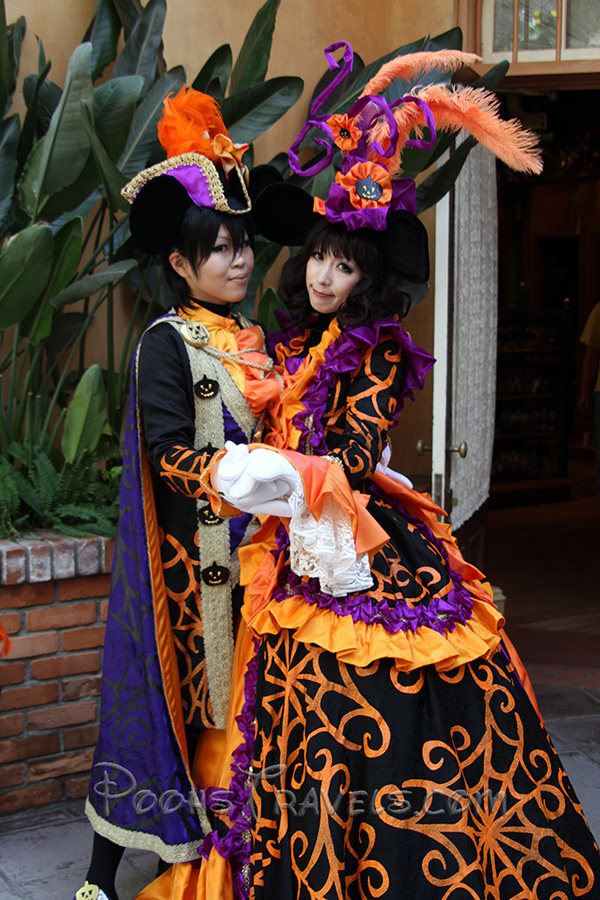
If you have any doubts about this, just visit Disney Tokyo at Halloween. It's completely INSANE. The combination of fervent Disney fans with fervent cosplay culture creates, for two weeks a year, a park like you've never seen. If you're thinking "what's the point of seeing an American theme park if I'm in Japan" - well, it's because you will NEVER see anything like this in America. While Americans treat Halloween as a time to dress up to express themselves, Japanese people in Disney collectively dress up to create the fantasy world of Disney inside the park.

Yes. That is real fur trim on the dress.
Disney Tokyo is the only Disney park worldwide that only allows Disney character costumes at Halloween, which means that the illusion of their fantasy world is reinforced by the dedication of the fans who dress up. So not only are you standing in front of Cinderella Castle, you're standing in front of Cinderella Castle surrounded by a hundred princesses, fairy godmothers, evil witches, and princes, many of whom are women who've dressed as men in order to create sets of characters with their friends.

And like the Disney Shibuya store, this isn't an event for children, but for young adults. So all the characters come in two varieties: regular and sexy.

As I suspected, there were no other unique varieties such as the Super Tigger I found in the Anaheim park. That kind of quirk of individualistic expression at Halloween is reserved for us crazy Americans.

People were glad to pose for photos, and would often even thank you for asking. Maybe it's just that Japanese people are super polite, or maybe I had just paid a compliment to their cosplay activities. My biggest challenge to getting good photos was more the lack of a good low-light camera than a lack of cooperation from the wonderfully dressed guests.


I also discovered that if I stopped any group of matching costumes for a photo, other Japanese people would crowd around for their own photos. It's almost like they wanted to ask, but were too polite to interrupt, and the rude American (uh, that's me) made it okay for them to take a photo too. Thus we had scenes like this one, where the group of evil witches from Snow White were trapped for about 10 minutes as a horde of Snow Whites took turns getting their photos taken with the group after I interrupted them to take a snapshot.

Note the Snow White standing off to the right. There are more Snow Whites next to her, all watching and waiting for their turn.
Ditto this group of aliens from Toy Story.
The favorite themes at Halloween were princesses (Cinderella, Belle, Aurora, Snow White with an occasional Rapunzel), Alice (wildly popular) often accompanied by a Queen of Hearts, and Toy Story characters Woody, Jessie, and Buzz.

I wonder how long he practiced his haughty Buzz Lightyear expression.
Villains didn't figure as prominently in Disney Halloween, as I expected. Out of the hundreds of elaborate dressed-up figures, there was one group of villains hanging out by the castle. I guess Japanese people prefer to be the good guys.

What these photos of individual costumes don't show, and what was the most wonderful part of the experience, is the sense of amazement I had seeing these very elaborate costumes everywhere in the park. Every time I turned around I saw someone who had put in more effort, worked up more detail, acting more in character, than I saw before. It was a breathtaking experience.

Yep. That's me in the Tigger outfit. 

If anyone is going to be in Tokyo on Halloween, and they want to know what Japan is about, a trip to Disney Tokyo is a must. While all the characters were created at the Mouse House in the US, there is something undeniably and uniquely Japanese about this experience. This is no pale reproduction of the real thing. This is the real Japan, taking something they like, embracing it, and executing on it like it's never been done before.


Wednesday, October 30, 2013

A Halloween tour around the world.

One of the wonders of Disney is that they are so effective at spreading American culture freaking everywhere. I mean, people in three different continents know what "Main Street USA" is supposed to look like, have heard barbershop quartets sing, and get immersed in all other kinds of nostalgic Americana. Disney doesn't just spread fairy dust and princesses, it's an engine for sharing the American dream and a lot of American culture.

Halloween is one of those examples. What the heck do Japanese people know about Halloween? But according to this blogger Disney Tokyo and Universal Studios Osaka have been almost the biggest influences in introducing Halloween to this country. As with any localization, they've taken some liberties and made some adjustments. Here are my observations on the flavors of Halloween.

The splash page for Hong Kong is all about chills and thrills at Halloween.

Hong Kong loves scary Halloween. What is it about Chinese people and ghostly spirits? I definitely grew up terrified of ghosts and convinced of their existence. Do Chinese people just like to get scared? They've got spooky trees and headless horsemen and haunted mansions. Plural.

It does seem like Hong Kong Halloween is targeted to adults. And not much emphasis on costumes.


Although Japan apparently have some scary-as-heck concepts of ghosts who are so evil they will kill you just for fun, their Halloween is a lot more upbeat, really cute and somewhat confused with a harvest festival.

Tokyo's idea of Halloween seems much cuter and cheerier than other versions.


Home-made costumes in Japan way surpass other costumes.


As the originator of cosplay, they also have some awesome costumes (seriously, check out the photos in this girl's trip report) and I'm really looking forward to getting a first-hand look at it tonight. Interesting quirk: Tokyo Disney is the only park that ONLY allows Disney costumes. Teenage Ninja Turtles - stay out. Ditto minions.

Somehow, Disney Paris has managed to work fashion into Halloween with a Minnie Couture fashion kind of a thing.

One of many treat stations around Disneyland Anaheim. People pay $64 to spend five hours collecting handfuls of chocolate in the park.


Disney Anaheim, the original American creation, is the place where Halloween is about candy, kids, and whatever thing you've thrown together called a costume. The trick or treating is a big deal, and something people come to the park for. Which I still don't understand, see my previous blog entry. The American parks are also the ones that have this warning on costumes: "Costumes should not contain weapons which resemble or could be easily mistaken for an actual weapon." Presumably because people running around with guns in the park is an actual scenario they've trained for, and they don't want to have to shoot you to protect the other guests.